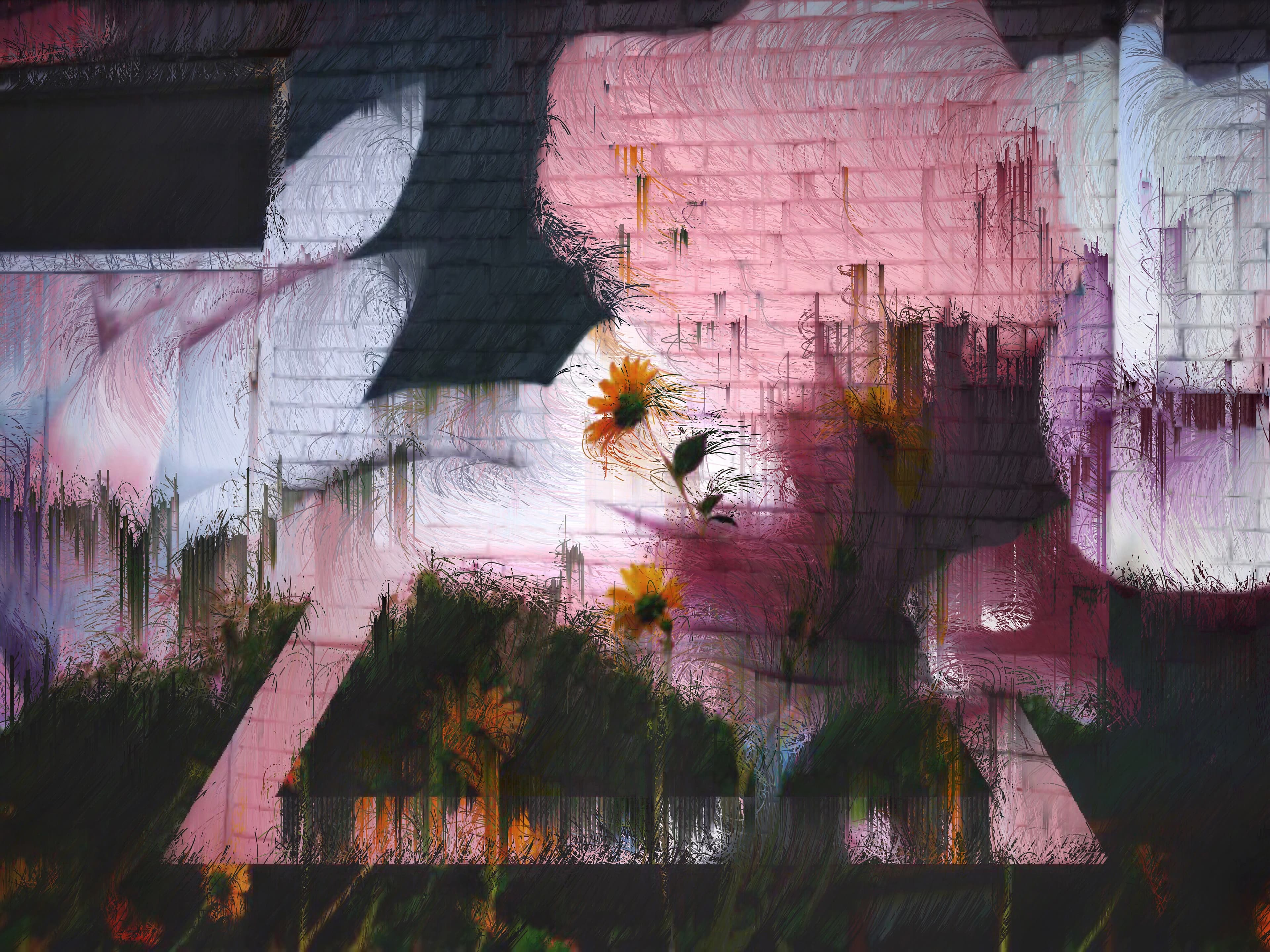
Glitch art is what happens when something breaks and the break is more interesting than what was supposed to be there.
It's a medium built on error. Corruption, malfunction, system failure — the moments when digital tools produce something unexpected, strange, or beautiful by accident. Glitch artists find those moments and learn how to create them deliberately.
The term covers a broad range of techniques and intentions. Some glitch artists work with pure software — corrupting image files, manipulating video data, writing code that produces controlled chaos. Others work with hardware — physically rewiring circuit boards, connecting devices in ways they were never meant to connect. Some are interested in the aesthetics. Some are interested in the philosophy. Most are interested in both.
◈ ◈ ◈
A BRIEF HISTORY
The history of glitch art starts before anyone called it that.
Nam June Paik, widely considered the father of video art, was experimenting with distorted television signals in the 1960s. He built custom electronics to manipulate broadcast signals in real time, treating the television as a tool for active creative intervention. The distorted, smeared images he produced came from the same impulse that drives glitch art today: using the failure states of technology as raw material.
In the 1980s and 90s, artists working with early computer hardware and video game systems discovered that their tools could be made to behave in ways their manufacturers never intended. JODI — the net.art collective formed by Joan Heemskerk and Dirk Paesmans — became known in the late 90s for work that made websites look broken, exploiting the visual language of system errors as artistic content.
The term "glitch art" solidified as a category in the 2000s, with the development of online communities and the gli.tc/h conference series — the primary gathering point for glitch art discourse. Artists like Rosa Menkman, whose "Glitch Studies Manifesto" became a foundational theoretical text, and Nick Briz, whose databending tutorials made the techniques accessible to a new generation, helped define the medium and its vocabulary.
Today glitch art exists as a recognized artistic practice with its own history, theory, critical literature, and community — and tools ranging from free software any beginner can use to hardware that takes years to master.
◈ ◈ ◈
CORE TECHNIQUES
Glitch art encompasses several distinct approaches, each producing different results and requiring different skills. Most practitioners work across multiple techniques.
DATABENDING
Databending is the practice of opening a media file in software that wasn't designed to handle it — importing an image into an audio editor like Audacity, for example — and applying effects built for sound, not images. The mismatch creates unpredictable visual artifacts: color band shifts, horizontal tearing, wave-like distortions.
It's one of the most accessible entry points into glitch art because the tools are free, the results are immediate, and the process is visual from the start. Nick Briz's databending tutorials and the resource compilation by Phillip Stearns are the essential beginner references.
DATAMOSHING
Datamoshing works with video. Video compression stores keyframes — complete snapshots — and then stores only the differences between frames. Datamoshing involves deleting or duplicating those keyframes, which forces the codec to apply motion data from one scene to the visual content of another. The result is footage that appears to melt, smear, or bleed across cuts. Takeshi Murata is among the most recognized practitioners.
PIXEL SORTING
Pixel sorting rearranges the pixels of an image according to a defined algorithm — sorting by brightness, color value, or saturation along rows or columns. The result is a characteristic streaking effect where bands of color extend across the image. Kim Asendorf, who developed one of the most widely used pixel sorting implementations, is among the most recognized practitioners. Processing and dedicated sorting tools are the standard entry points.
FILE FORMAT MANIPULATION
Every digital file has a specific internal structure. File format manipulation means opening a file in a hex editor and directly altering the data — breaking the expected structure in ways that corrupt the output without destroying it entirely. JPEG corruption tends to produce blocky color artifacts and smearing. Video format corruption can produce motion trails and visual noise.
CIRCUIT BENDING
Circuit bending bridges software and hardware. It involves physically modifying electronic circuits — connecting points that weren't meant to be connected, introducing voltages that cause unexpected outputs. Applied to video mixers, game consoles, or cameras, it produces visual distortions that no software can replicate. The results have a distinctive analog quality that separates them immediately from digital glitch work.
◈ ◈ ◈
TOOLS TO GET STARTED
For beginners, Audacity-based databending is the lowest barrier to entry.
You need: a digital image file (JPEG works well), Audacity (free, cross-platform), and optionally a hex editor (Hex Fiend for Mac, HxD for Windows).
The process: import the image into Audacity as raw data, apply audio effects like reverb or echo, export back as the original format. Results vary — trial and error is fundamental.
For pixel sorting: Processing with Kim Asendorf's sorting library, or Clinton McKay's standalone pixel sorting application.
For video work: FFMpeg (command-line video processor), AviGlitch (Ruby-based), Avidemux.
For cross-medium work: Photosounder converts between sound and image formats, opening another dimension of manipulation.
◈ ◈ ◈
THEORY AND PHILOSOPHY
Glitch art has generated serious critical writing. Understanding it isn't required to practice, but it illuminates why artists are drawn to error as subject matter.
Rosa Menkman's "Glitch Studies Manifesto" (2009) is the foundational text. It positions glitch not as a side effect to be avoided but as a legitimate aesthetic territory — a site where the assumptions built into digital systems become visible.
Kim Cascone's "The Aesthetics of Failure" examines how malfunction and noise function as expressive material in electronic music and visual art.
Legacy Russell's "Glitch Feminism" extends the metaphor of glitch into social and political territory — arguing that the refusal of a body or identity to conform to expected behavior is itself a form of glitch.
Iman Moradi's "Glitch: Designing Imperfection" provides systematic analysis of glitch as design methodology. Daniel Temkin and Hugh Manon's "Notes on Glitch" situates the medium within contemporary art history.
◈ ◈ ◈
NOTABLE ARTISTS
Rosa Menkman — Dutch artist and theorist. Author of the Glitch Studies Manifesto. Her work examines compression artifacts and feedback loops.
Nick Briz — Chicago-based artist and educator. His databending tutorials have made glitch techniques accessible to a generation of practitioners.
Kim Asendorf — German artist best known for pixel sorting work and his influence on how the technique spread through visual culture.
JODI (Joan Heemskerk and Dirk Paesmans) — Belgian-Dutch duo whose net.art work in the 90s established glitch as a deliberate artistic choice rather than an accident.
Takeshi Murata — New York-based artist whose datamoshing video work brought the technique to wider art world attention.
Corey Arcangel — American artist working with obsolete technology, hacked game cartridges, and corrupted media across video, music, and installation.
Phillip Stearns — Artist and educator who translates digital corruption into woven textile structures. His glitch textiles are among the most distinctive objects to come out of the medium.
Jon Cates and Nick Briz are associated with "dirty new media" — a Chicago-based movement that embraces lo-fi aesthetics and amateur production as political positions.
◈ ◈ ◈
WHERE TO GO FROM HERE
The gli.tc/h conference wiki documents artists, methodologies, and events. Nick Briz's tutorials at nickbriz.com/databending101 and the resource compilation at phillipstearns.wordpress.com/glitch-art-resources are the best starting points for anyone who wants to practice.
For buying and selling original human-made glitch art — made by real artists with real practices — the CKURO.ART marketplace is built for that. Every artist is verified human. Every piece is original.
The medium rewards experimentation. Start breaking things.
Blog → Technique
What Is Glitch Art? A Complete Guide to the Medium, Techniques, and Artists
◈ C. KURO04/24/20268 MIN READ_
glitch artdatabendingdatamoshingpixel sortingdigital arttutorial
▍ COMMENTS · 0
No comments yet. Be the first.